
A Brief History of The Inner Game
An account by Tim Gallwey
In 1971, while on sabbatical from a career in higher education, I took a job as tennis professional in Seaside, California. While teaching on the court one day, I realized that many of my instructions were being incorporated in the student’s mind as a kind of “command and control” self-dialogue that was significantly interfering with both learning and performance. When I inquired further, I found there was a lot going on in the mind of my tennis students that was preventing true focus of attention.
I then began to explore ways to focus the mind of the player on direct and non-judgmental observation of ball, body, and racquet in a way that would heighten learning, performance, and enjoyment of the process. With this new awareness, amateur tennis players seemed to naturally develop the instincts and physicality of much more experienced players without specific instruction.
In 1974, initial experiments and their surprising results were published as The Inner Game of Tennis. The book surpassed expectations of both author and publisher by selling over one hundred times more copies than predicted and soon became a New York Times Bestseller.
Shortly thereafter, KCET produced a six-part nationally viewed TV series called Inner Tennis, each of which focused on a particular theme such as overcoming fear, achieving concentration, breaking bad habits, etc. Inner Skiing applied the same learning techniques to an icier sport and dealt specifically with overcoming the various kinds of fear commonly experienced in that sport.
In 1980, Random House asked me to write The Inner Game of Golf and to, in doing so, describe the learning from the point of view of a student of the game, which I was. Perhaps more than in any other major sport, the golfer is vulnerable to subtle shifts in mindset, which can have drastic impact on one’s performance. About that time Barry Green, then the lead bassist for the Cincinnati Philharmonic Orchestra approached me to collaborate on The Inner Game of Music, another activity in which both the fear of failure and doubt can be anathema to the quality of performance.
Starting in the mid-seventies, many corporate leaders and managers recognized the implications of Inner Game concepts and began to use them as models for facilitating desired changes in the workplace.
One of my first long-term clients was AT&T. In the early 1980′s, they were faced with the challenge of changing the mindset of the largest company in the U.S. from the “bell shaped head” of monopolistic thinking to the mindset of a competitive, market-driven, entrepreneurial company.
Not long after, I was asked to help IBM to change its prevailing corporate attitude of “we know it all” to that of a learning and coaching organization. Inner Game methods were then put to use in Apple Computer Company’s Leadership Development program.
And, in the 1990′s, Inner Game methods were used to train the top-level managers of The Coca-Cola Company in how to coach their employees, better develop the skills of their work teams, and, eventually, to move towards becoming a learning organization.
Hundreds of keynote addresses were delivered on a wide range of Inner Game applications including Achieving Excellence in Performance, Learning to Learn in an Age of Change, The Inner Games of Management, Leadership and Coaching, as well as The Inner Game of Work. It was easy for me to apply the Inner Game principles to any corporate application because the foundation was simple and universal. Often I used tennis, golf, or skiing demonstrations to make visible the dramatic changes that could take place with a different approach to coaching.
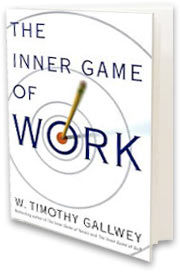
The Inner Game of Work, published in 1999, is an inside look at how the Inner Game methods and models have been applied by many individuals, in a wide variety of companies, over the past twenty years. Mostly, it is focused on the attainment of individual excellence. With the turn of the century, the focus of my own interest had turned towards The Inner Game of Teams. The work of overcoming the obstacles faced in people working together effectively is both challenging and fascinating. In the last half of 1999, I helped facilitate over 50 workshops with teams, and joined forces with Dr. Valerio Pascotto to do what I believe is pioneering work in the field of people learning to work effectively together.
In my work with teams and companies, I found that a primary obstacle for most in the pursuit of a goal seemed to be stress. In 2009, I collaborated with two respected physicians, Dr. John Horton and Dr. Ed Hanzelik, to study how stress affects our bodies and minds. We explored how the Inner Game principles could help with not only stress management, but stress reduction and prevention. From this research evolved into The Inner Game of Stress.
After finding such a meaningful cyclical relationship between work and stress, I couldn’t help but yearn for a way to help individuals navigate the quagmire caused by stress, work, and the desire to meet goals. It seemed one on one coaching was the best way to do this, but it would be impossible to reach everyone who needed help in this way. With the help of Myles Downey, founder of Performance Coaching International, Gary Wessely, and Richard Merrick, we developed an eCoach as a pilot that was designed to aid individuals in meeting their desired goals. This program utilized the Inner Game principles to guide coaches through personalized sessions aimed towards finding and eliminating obstacles, breaking limiting patterns, and making progress toward both long and short-term goals. Since then, this proof of concept has evolved into the soon to be unveiled “Life University” (Life U).
In 2012, the The Inner Game International School of Coaching was Launched in Brazil. As of 2017, The Inner Game Schools are now active in Brazil, Italy, Spain, Czech Republic, and in the U.S. by the and of 2017. Learn more about the The Inner Game Schools…
Available Inner Game Books
The Inner Game of Tennis

The Inner Game of Golf

The Inner Game of Work
The Inner Game of Skiing

The Inner Game of Stress

The Inner Game of Music

An account by Tim Gallwey
In 1971, while on sabbatical from a career in higher education, I took a job as tennis professional in Seaside, California. While teaching on the court one day, I realized that many of my instructions were being incorporated in the student’s mind as a kind of “command and control” self-dialogue that was significantly interfering with both learning and performance. When I inquired further, I found there was a lot going on in the mind of my tennis students that was preventing true focus of attention.
I then began to explore ways to focus the mind of the player on direct and non-judgmental observation of ball, body, and racquet in a way that would heighten learning, performance, and enjoyment of the process. With this new awareness, amateur tennis players seemed to naturally develop the instincts and physicality of much more experienced players without specific instruction.
In 1974, initial experiments and their surprising results were published as The Inner Game of Tennis. The book surpassed expectations of both author and publisher by selling over one hundred times more copies than predicted and soon became a New York Times Bestseller.
Shortly thereafter, KCET produced a six-part nationally viewed TV series called Inner Tennis, each of which focused on a particular theme such as overcoming fear, achieving concentration, breaking bad habits, etc. Inner Skiing applied the same learning techniques to an icier sport and dealt specifically with overcoming the various kinds of fear commonly experienced in that sport.
In 1980, Random House asked me to write The Inner Game of Golf and to, in doing so, describe the learning from the point of view of a student of the game, which I was. Perhaps more than in any other major sport, the golfer is vulnerable to subtle shifts in mindset, which can have drastic impact on one’s performance. About that time Barry Green, then the lead bassist for the Cincinnati Philharmonic Orchestra approached me to collaborate on The Inner Game of Music, another activity in which both the fear of failure and doubt can be anathema to the quality of performance.
Starting in the mid-seventies, many corporate leaders and managers recognized the implications of Inner Game concepts and began to use them as models for facilitating desired changes in the workplace.
One of my first long-term clients was AT&T. In the early 1980′s, they were faced with the challenge of changing the mindset of the largest company in the U.S. from the “bell shaped head” of monopolistic thinking to the mindset of a competitive, market-driven, entrepreneurial company.
Not long after, I was asked to help IBM to change its prevailing corporate attitude of “we know it all” to that of a learning and coaching organization. Inner Game methods were then put to use in Apple Computer Company’s Leadership Development program.
And, in the 1990′s, Inner Game methods were used to train the top-level managers of The Coca-Cola Company in how to coach their employees, better develop the skills of their work teams, and, eventually, to move towards becoming a learning organization.
Hundreds of keynote addresses were delivered on a wide range of Inner Game applications including Achieving Excellence in Performance, Learning to Learn in an Age of Change, The Inner Games of Management, Leadership and Coaching, as well as The Inner Game of Work. It was easy for me to apply the Inner Game principles to any corporate application because the foundation was simple and universal. Often I used tennis, golf, or skiing demonstrations to make visible the dramatic changes that could take place with a different approach to coaching.
The Inner Game of Work, published in 1999, is an inside look at how the Inner Game methods and models have been applied by many individuals, in a wide variety of companies, over the past twenty years. Mostly, it is focused on the attainment of individual excellence. With the turn of the century, the focus of my own interest had turned towards The Inner Game of Teams. The work of overcoming the obstacles faced in people working together effectively is both challenging and fascinating. In the last half of 1999, I helped facilitate over 50 workshops with teams, and joined forces with Dr. Valerio Pascotto to do what I believe is pioneering work in the field of people learning to work effectively together.
In my work with teams and companies, I found that a primary obstacle for most in the pursuit of a goal seemed to be stress. In 2009, I collaborated with two respected physicians, Dr. John Horton and Dr. Ed Hanzelik, to study how stress affects our bodies and minds. We explored how the Inner Game principles could help with not only stress management, but stress reduction and prevention. From this research evolved into The Inner Game of Stress.
After finding such a meaningful cyclical relationship between work and stress, I couldn’t help but yearn for a way to help individuals navigate the quagmire caused by stress, work, and the desire to meet goals. It seemed one on one coaching was the best way to do this, but it would be impossible to reach everyone who needed help in this way. With the help of Myles Downey, founder of Performance Coaching International, Gary Wessely, and Richard Merrick, we developed an eCoach as a pilot that was designed to aid individuals in meeting their desired goals. This program utilized the Inner Game principles to guide coaches through personalized sessions aimed towards finding and eliminating obstacles, breaking limiting patterns, and making progress toward both long and short-term goals. Since then, this proof of concept has evolved into the soon to be unveiled “Life University” (Life U).
In 2012, the The Inner Game International School of Coaching was Launched in Brazil. As of 2017, The Inner Game Schools are now active in Brazil, Italy, Spain, Czech Republic, and in the U.S. by the and of 2017. Learn more about the The Inner Game Schools…
Connect with the Inner Game
We would love to hear from you!
Request a consultation. Send an inquiry.
Share your feedback and questions...


More Info
Tim Gallwey lives in Thousand Oaks CA, and when he isn’t touring the globe on speaking engagements, he’s facilitating workshops and The School in LA, and working on ways to make the applications of the Inner Game more accessible internationally to corporations and various conventions on coaching, learning, and peak performance and most importantly continuing to learn more and more in his own understanding the inner dimension of his own life..
Address:
14011 Ventura Blvd Suite 502, Sherman Oaks CA 91432